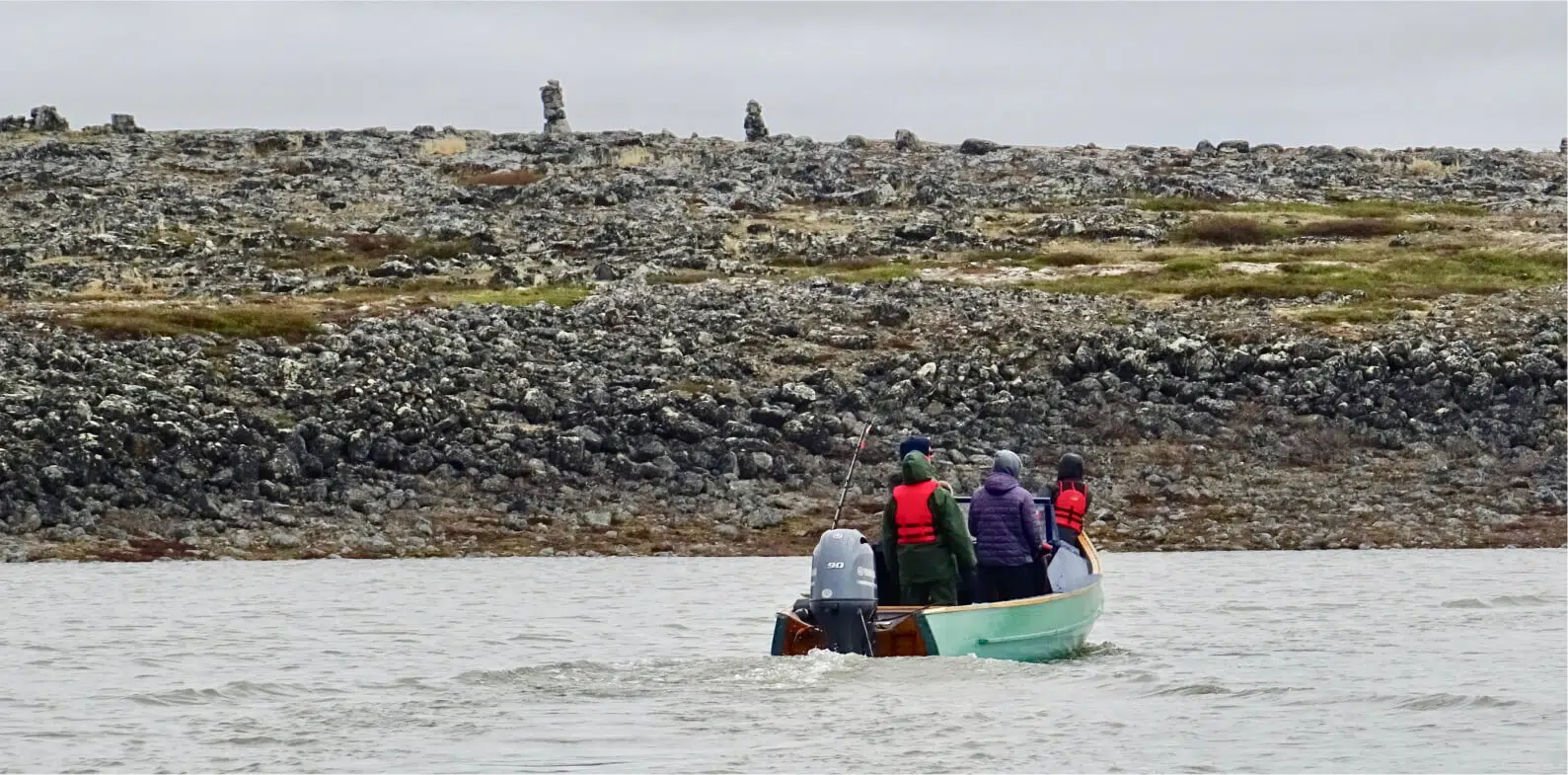
Approaching the site of Inuksualuit. © Yvan Pouliot
Kuuvik Bay, Where Aukkautik Lived
K uuvik is the northernmost major river of the west coast of Nunavik, Québec. Several islands are at its mouth, including Aqiggituut which means abundant with ptarmigans. Inuit knew of the abundance of seals and whales in this area, making it an ideal place for Inuit families to winter.
The Kuuvik area teemed with iqalukpik (arctic char) whose seasonal migration to the sea in the spring brought Inuit to Kuuvik and then again in the fall when the fish were migrating upstream to the lakes for spawning. Kuuvik means a place to where other streams flow.
Kuuvik and the surrounding area has been inhabited by Inuit since time immemorial. It is favoured by Inuit of Ivujivik, Salluit, Akulivik and Puvirnituq. The Inuit value this area so much they initiated a project and formed a committee to protect the area from overfishing, poaching and other unwanted acts. The committee’s existence was noticed by the environmental authorities of the provincial government which then arranged for it to become a designated aquatic reserve in 2019, giving it protection from possible developments.
Around 120 years ago, strange events forced families to abandon the area of Kuuvik. The Inuit moved to different places throughout Nunavik and beyond. Several families lived together in relative peace in Kuuvik. The sea provided seal for feeding and clothing the Inuit, fueling the lamps that heat their igluit, and parts for their tools and qajait (several qajaq). As the short days of winter of 1899 made way to ullutusiq, a period of longer daylights, the capable Inuit men went out to the sea ice to harvest seals, Aukkautik being one of them. Aukkautik was a very capable, strong but kind man and he was married with two children. As such, he tended for his family and his community.
On that fateful day he went on an outing to the sea ice to harvest game, bringing the adopted son of his neighbour with him. During that hunt, he accidentally shot the boy, wounding him fatally. Enraged, the boy’s father murdered Aukkautik’s wife and children while he walked back to fetch the boy’s body with a polar bear skin. Upon returning to his home and discovering the lifeless bodies of his loved ones, Aukkautik became mad and shot at all the Inuit who approached. A survivor of his attacks arrived at Ijaittuit, a camp south of Kuuvik, and the terror of Aukkautik then spread. Every person capable of walking trekked to places as far away as Salluit and Kangiqsujuaq. Many abandoned their campsites in order to move quickly, but because they were unprepared, some died from exhaustion and hunger along the route.
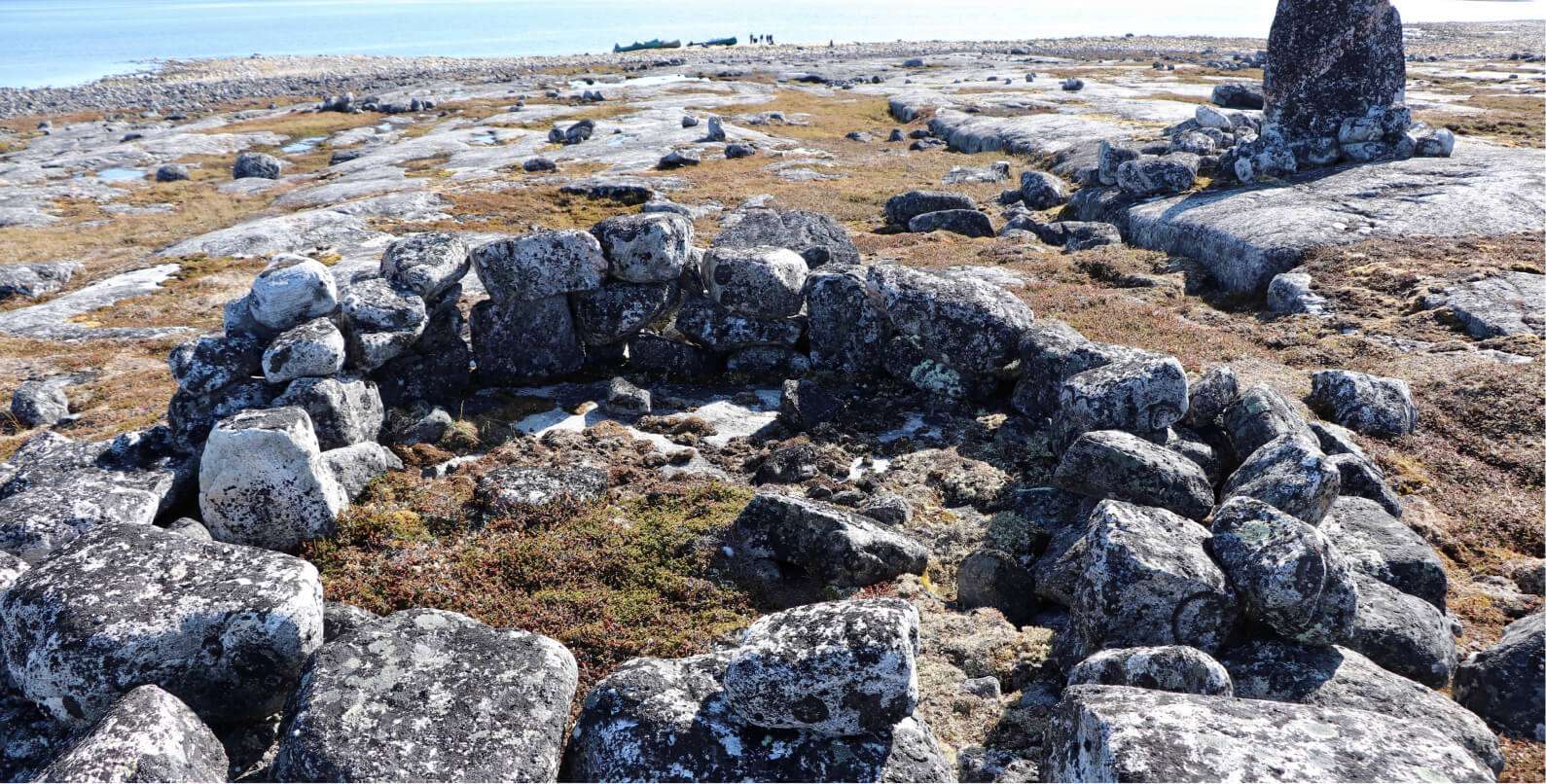
Heavily stoned structure of an old dwelling at Inuksualuit site. These structures would be a few centuries old. © Yvan Pouliot
The Aarsiq Theatre Company, which carries out cultural projects in Nunavik, is preparing a play based on this true story that has been passed down through generations. It was the president of Aarsiq, Adamie Kalingo from Ivujivik, with participants of a theater workshop a few years ago, who identified the story of Aukkautik as a project to realize. A second workshop with Inuit elders and relatives of Aukkautik was held in Ivujivik in 2019 as a way to gain their perspective and keep them informed. The play will be performed by young Nunavimmiut in 2023.
In order to immerse ourselves in the places where the various events of this story took place, Aarsiq, under the leadership of Adamie, organized a canoe expedition to the Kuuvik region. We set up a camp in July 2021 on Aqiggituut Island, the focal point of the story, and spent three days exploring the various sites selected by Adamie and an elder from Akulivik who knows the area, Juanasie Qaqqutuq.
As evidenced by the presence of a multitude of old inuksuit along our route, this region has clearly been occupied by the Inuit for the past several centuries. In a place called Inuksualuit, there is an impressive concentration of rock structures such as caches, fox traps, inuksuit (plural of inuksuk) and former Inuit dwellings. We even observed a qaggiq, a structure used for festivities and by angakkuit (Inuit shamans). According to Adamie, the site appeared to have been a place of caribou hunting. Inuksuit were sometimes used as a visual barrier to direct caribou to a point where hunters were awaiting them.
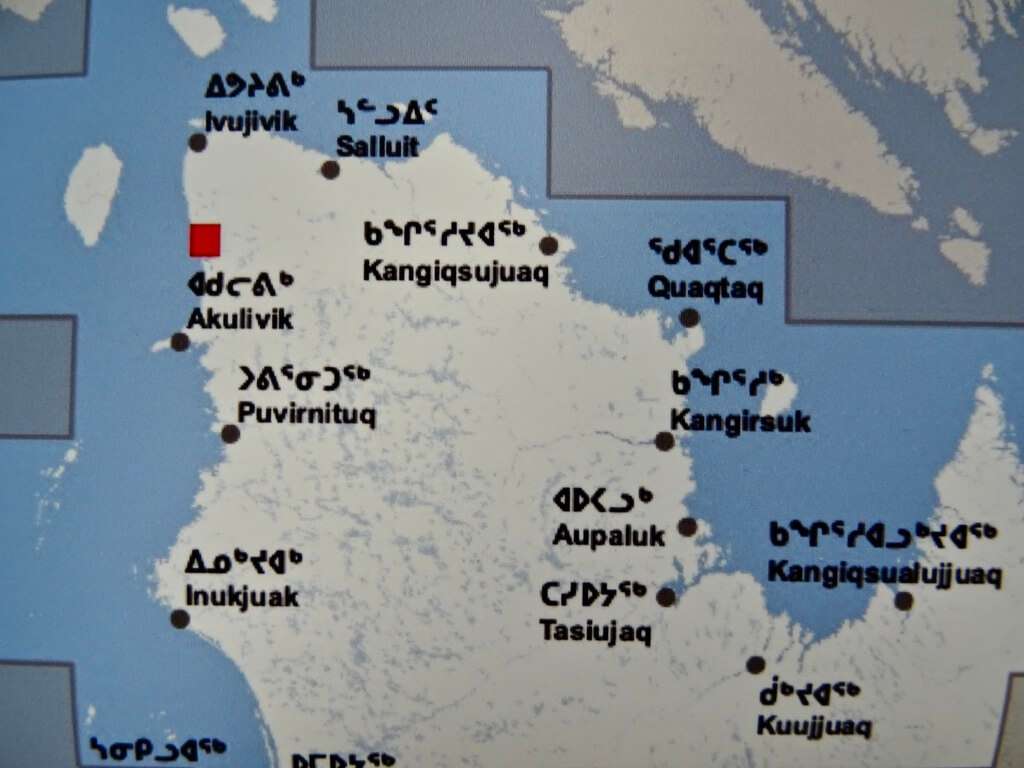
The red square shows the location of Kuuvik Bay and Aqiggituut island.
According to Adamie, the site appeared to have been a place of caribou hunting. Inuksuit were sometimes used as a visual barrier to direct caribou to a point where hunters were awaiting them.
To find out more about the Inuksualuit site, we spoke to an archaeologist from the Avataq Cultural Institute. The archaeologist told us that it is a site registered by the Institute and is described as follows: “This site is established on a rocky ridge bordered by a field of boulders. Visible from afar by the presence of many inuksuit, it contains more than one hundred archaeological structures: heavily stoned tent structures, food caches, hunting lookouts, fox traps, qajaq racks, a qaggiq and many inuksuit.” She adds that the presence of a qaggiq indicates that it must have been an important meeting place and she estimates the age of these structures between 100 and 300 years, which corresponds to the pre‐contact period. Such a place was possibly occupied in the days of Aukkautik. Like many sites of this kind, it was located next to a field of boulders for practical reasons: to be near the raw material, so as not to have to transport it long distances.
Sites like Inuksualuit are therefore relatively young compared to the overall period of Inuit occupation in Nunavik. Avataq’s archeologist mentions that another people, different from today’s Inuit, arrived in the Arctic about 4,000 years ago (Pre‐Dorset). The oldest recorded site in Nunavik, dating back 4,400 years, was found near Ivujivik. This people disappeared around 900 years ago (Dorset or Tuniit). The direct ancestors of today’s Inuit, referred to as Thule people, arrived in the Arctic about 800 years ago. The oldest Thule site found in Nunavik dates back 750 years and is located near Akulivik, not far from the starting point of our expedition.
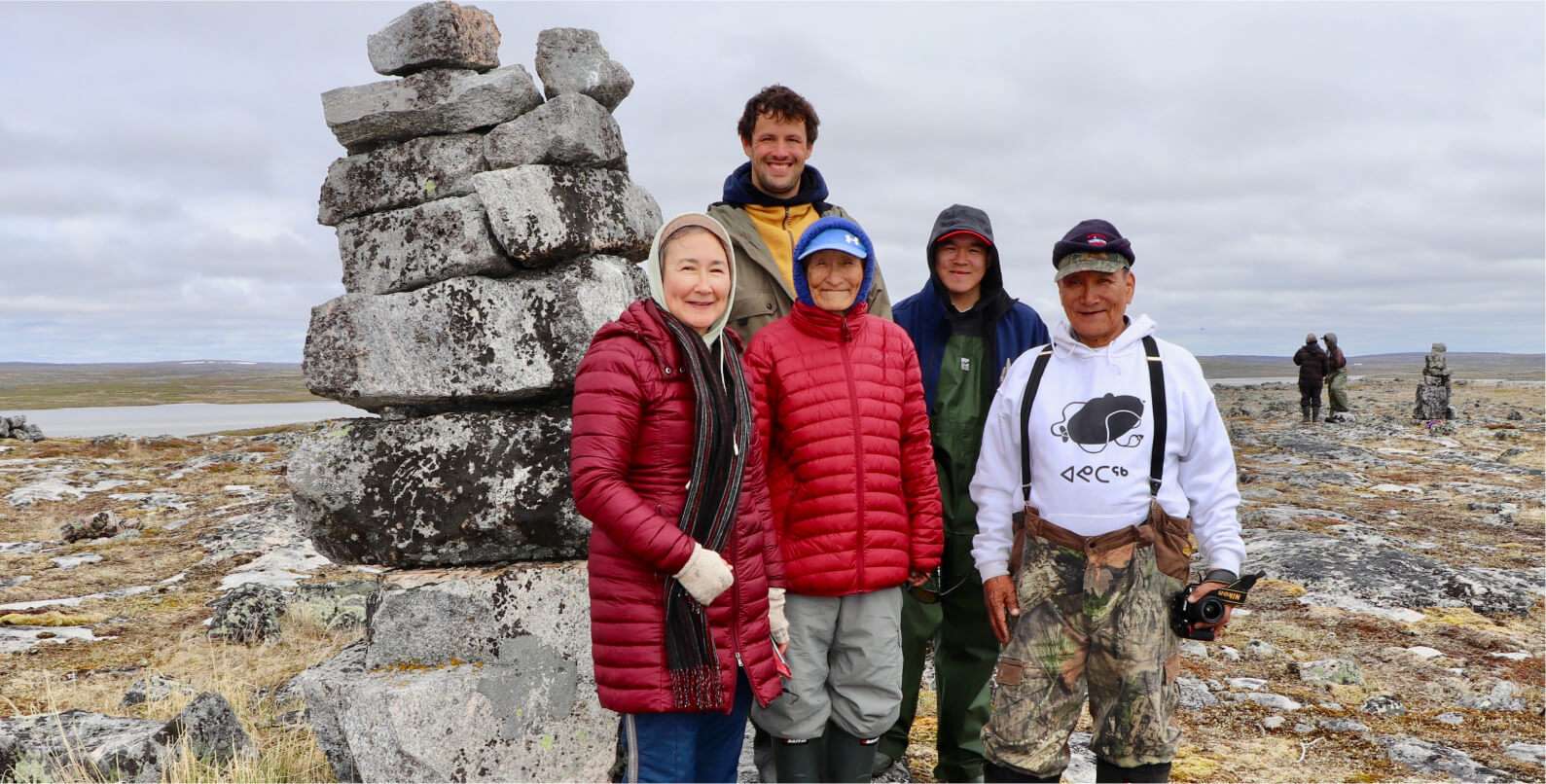
Lisa Koperqualuk, Gabriel Leger-Savard, Susie Kalingo, Piita Nauja Qumaq and Adamie Kalingo. © Yvan Pouliot
During our exploration, Adamie remarked to us: “It is easy to understand why Aukkautik was living in this region. Game is plentiful, especially iqalukpik which is caught upstream under the ice in spring, and near the sea in early fall. In addition there are sites nearby where walruses used to congregate in the past. The walrus was very important at that time, especially for feeding sled dogs. We visited two places associated with this marine mammal: Aivirsiuvik and Qairtuajuit. The presence of flat and smooth bedrock in these places to rest in groups (ullik) as well as sandy shoals to feed on molluscs make them favorite places for walruses. They are unfortunately no longer present today following intensive harvesting in the 19th and 20th centuries—or their meat, fat and the ivory of their tusks—which decimated several populations.
For Aukkautik, the Kuuvik region was indeed a good place to live. This rich environment where fresh water and salt water meet, supports an abundant wildlife. The relatively flat landscape allows one to see any intruder approaching from a distance. It is also a place where sea and land are inextricably intertwined, making it difficult for anyone unfamiliar to find their way around. Aukkautik has long sowed terror in Kuuvik and his story is still vivid in the collective memory of Nunavimmiut. Adamie mentioned during our trip that “Kuuvik Bay would be a very good place to live and if there is no Inuit community here today, it is possibly because Aukkautik made everyone flee the place!”